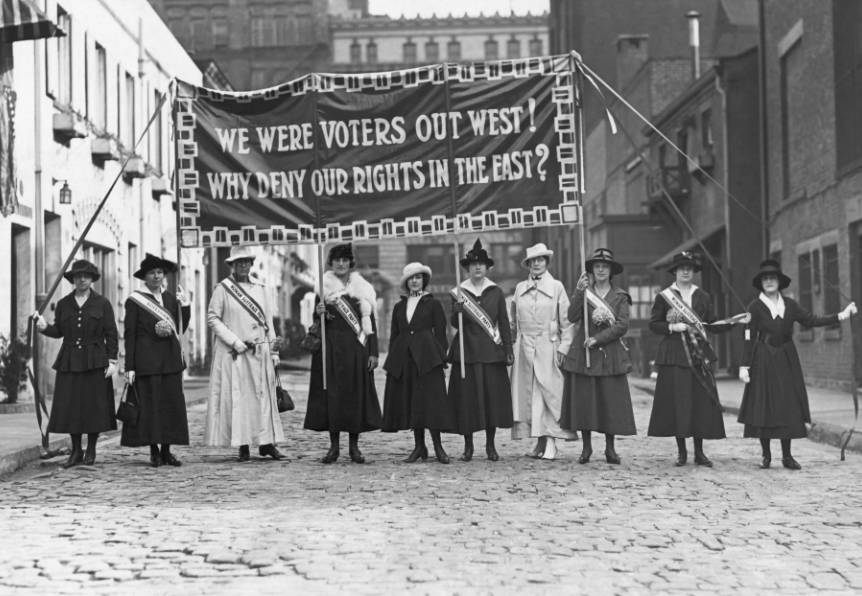
The women's suffrage movement was a decades-long fight to win the right to vote for women in the United States. It took activists and reformers nearly 100 years to win that right, and the campaign was not easy: Disagreements over strategy threatened to cripple the movement more than once.
The Early Movement
The women's suffrage movement began in the 1840s, though women had been fighting for equal rights for much longer. The first formal meeting on women's rights took place in 1848 at the Seneca Falls Convention in New York, organized by Elizabeth Cady Stanton and Lucretia Mott.
At the convention, Stanton drafted a Declaration of Sentiments, modeled after the Declaration of Independence, that called for women's equality in all areas of life, including the right to vote. While the idea was radical at the time, it laid the foundation for the suffrage movement.
The Split in the Movement
After the Civil War, the women's suffrage movement split over the 15th Amendment, which gave voting rights to African American men but not to women. Some suffragists, led by Stanton and Susan B. Anthony, opposed the amendment unless it also granted women the vote.
Others, led by Lucy Stone and Julia Ward Howe, supported the amendment as a step toward universal suffrage, even if it didn't include women. This split led to the formation of two rival organizations: the National Woman Suffrage Association (NWSA) and the American Woman Suffrage Association (AWSA).
A New Strategy
In the early 20th century, a new generation of suffragists emerged, led by Carrie Chapman Catt. Under her leadership, the NWSA and AWSA merged in 1890 to form the National American Woman Suffrage Association (NAWSA).
Catt developed a "Winning Plan" that focused on winning suffrage at the state level before pushing for a federal amendment. This strategy proved successful, and by 1918, more than half of the states had granted women some form of voting rights.
Protests and Militancy
While NAWSA focused on state-by-state campaigns, a more militant group called the National Woman's Party (NWP), led by Alice Paul, used more aggressive tactics. They organized protests, picketed the White House, and even went on hunger strikes when they were arrested.
These tactics drew attention to the suffrage cause but also faced criticism from more moderate suffragists. However, they played a key role in keeping the issue in the public eye and pressuring President Woodrow Wilson to support a federal amendment.
Victory: The 19th Amendment
On August 18, 1920, the 19th Amendment to the U.S. Constitution was ratified, granting women the right to vote. The amendment stated: "The right of citizens of the United States to vote shall not be denied or abridged by the United States or by any State on account of sex."
This victory was the result of decades of hard work by countless women and men who fought for equality. However, it's important to note that the 19th Amendment didn't guarantee voting rights for all women. Many women of color continued to face barriers to voting, such as literacy tests and poll taxes, until the passage of the Voting Rights Act of 1965.
Global Impact
The American women's suffrage movement inspired similar movements around the world. New Zealand became the first country to grant women the right to vote in 1893, followed by Australia in 1902, Finland in 1906, and the United Kingdom in 1918 (for women over 30).
Today, women's suffrage is recognized as a fundamental human right, but the fight for gender equality continues in many areas, including pay equity, reproductive rights, and representation in politics.
Legacy
The women's suffrage movement was a pivotal moment in American history that transformed the nation's democracy. It demonstrated the power of grassroots activism, persistence, and the belief in equality for all.
The legacy of the suffragists lives on in the millions of women who exercise their right to vote today and in the ongoing fight for gender equality around the world.