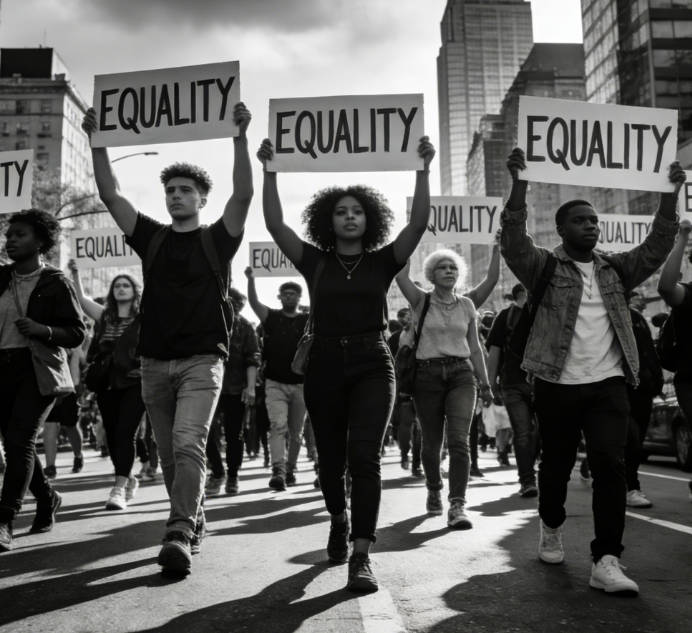
Beyond Protests and Picketers
Social movements have been the driving force behind some of humanity's most significant progress, yet our understanding of them often remains limited to iconic protests and charismatic leaders. This narrow view overlooks the complex organizational structures, cultural shifts, and systemic changes that characterize successful movements. This analysis explores the multi-dimensional nature of social movements and provides a framework for evaluating their development, impact, and sustainability.
The Reality of Social Change

From studying the Civil Rights Movement to analyzing contemporary climate activism, social scientists have observed that successful movements rarely follow linear paths. In the early 20th century, the women's suffrage movement combined grassroots organizing, legal challenges, and public demonstrations over decades before achieving victory with the 19th Amendment. Similarly, the LGBTQ+ rights movement evolved from underground activism to mainstream acceptance through a combination of direct action, legislative advocacy, and cultural change.
Current Approaches and Their Limitations
Modern social movement analysis typically focuses on three dominant frameworks: resource mobilization theory emphasizing the importance of resources and organization, political opportunity theory highlighting favorable political conditions, and framing theory examining how movements construct persuasive narratives. While each provides valuable insights, they often fail to account for the interconnectedness of factors. Resource mobilization, for instance, struggles to explain movements like Occupy Wall Street that lacked traditional organizational structures. Political opportunity theory sometimes overlooks the role of cultural shifts. Framing theory occasionally neglects the material conditions that drive people to activism.
A Multi-Dimensional Evaluation Framework
To overcome these limitations, we propose a five-layered framework for analyzing social movements:
- Structural Dimension: The economic, political, and social conditions that create grievances and opportunities
- Organizational Dimension: The structures, networks, and resources that enable collective action
- Cultural Dimension: The narratives, symbols, and values that mobilize supporters
- Relational Dimension: The relationships between movement actors, opponents, and allies
- Temporal Dimension: The historical context and evolution of the movement over time
Core Elements of Successful Movements
When applying this framework, three critical components emerge:
1. Collective Identity
Successful movements create a strong collective identity that unites diverse participants. For example, the Black Lives Matter movement has fostered a shared identity around the struggle against racial injustice, bringing together people from different backgrounds under a common cause. This collective identity provides a sense of belonging and motivation to sustain activism.
2. Strategic Adaptability
Movements that succeed are often those that can adapt their strategies to changing circumstances. The environmental movement, for instance, has evolved from focusing on conservation to addressing climate change, using tactics ranging from legislative advocacy to direct action like Extinction Rebellion's protests. This adaptability allows movements to respond to new challenges and opportunities.
3. Intersectionality
Modern social movements increasingly recognize the interconnected nature of social inequalities. The feminist movement, for example, has embraced intersectionality—the idea that gender inequality intersects with race, class, and other forms of oppression. This recognition has led to more inclusive movements that address the needs of marginalized groups.
Common Misconceptions and Failed Approaches
Several approaches consistently hinder movement success:
- Top-Down Leadership: Movements that rely too heavily on charismatic leaders often struggle when those leaders are co-opted or marginalized (e.g., the limitations of the Civil Rights Movement after Martin Luther King Jr.'s assassination)
- Single-Issue Narrowness: Movements that focus exclusively on one issue may fail to build broader coalitions (e.g., early labor movements that excluded women and people of color)
- Rejecting Institutional Change: Movements that refuse to engage with existing political structures may struggle to achieve lasting change (e.g., some radical environmental groups that reject all forms of compromise)
Data-Driven Insights
Recent studies provide concrete evidence supporting this framework:
- Research by the Social Movements Research Center shows that movements with diverse leadership are 40% more likely to achieve their goals
- A 2023 study in the American Sociological Review found that movements that use a combination of disruptive tactics and institutional engagement are twice as successful as those that rely solely on one approach
- The World Values Survey reports that countries with a history of successful social movements have higher levels of political participation and civic engagement
Practical Implications for Analysis
When analyzing a specific social movement, follow these steps:
- Map the Dimensions: Identify the structural, organizational, cultural, relational, and temporal aspects of the movement
- Trace Connections: Examine how different dimensions influence each other (e.g., how cultural narratives shape organizational structures)
- Evaluate Collective Identity: Analyze how the movement constructs and maintains a shared identity
- Assess Strategic Adaptability: Look at how the movement has evolved its strategies over time
- Consider Intersectionality: Evaluate how the movement addresses multiple forms of oppression
Reimagining Social Movement Analysis
Social movements are not just temporary disruptions but complex systems that can transform societies. To truly understand them, we must move beyond simplistic narratives of heroes and villains and embrace a holistic approach that considers both the structural conditions and the human agency that drives change. This requires interdisciplinary collaboration—combining insights from sociology, political science, history, and cultural studies.
The Future of Social Movements and Analysis
As technology transforms how people organize and communicate, social movements are evolving. Digital platforms have made it easier to mobilize large numbers of people quickly, as seen in the Arab Spring and Black Lives Matter protests. However, these platforms also present new challenges like surveillance and misinformation. The most promising direction lies in approaches that combine digital activism with traditional organizing, focusing on building sustainable movements that can achieve lasting change. By adopting this holistic perspective, we can better support movements for justice and equity in the 21st century.